Best Scuba Fins in 2026
The Cressi Frog Plus at $118.95 is the best scuba fin for most divers: a soft open heel paddle that flutter kicks easily, forgives untrained ankles, and takes a boot so it works on shore entries and in cold water. Technical divers who frog kick and back kick should pay $219 for the Apeks RK3 HD instead.
Fins are the only thing on a diver that produces movement, and the wrong pair does not merely slow you down: it burns your calves, raises your breathing rate and shortens the dive for everyone on the boat. The choice comes down to foot pocket type and blade stiffness, matched to your legs and your entries rather than to a marketing claim. For most divers the answer is the Cressi Frog Plus at $118.95.
A scuba fin is a lever: your leg supplies force at the foot pocket, the blade presses against a much larger area of water, and the result is thrust in exchange for effort. Every design decision in the category, blade length, stiffness, venting, channel shape and articulation, is a different answer to the same question of how much effort to charge you per unit of thrust, and at what point in the kick cycle to charge it.
Best scuba fins by experience level

Cressi Frog Plus Adjustable Open Heel Fins
A soft open heel paddle that works well for flutter kicking and is forgiving of untrained ankles. The default recommendation for a first pair of open heel fins.
Best for: A first pair of open heel fins with boots
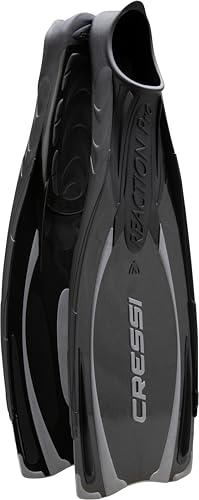
Cressi Reaction Pro Full Foot Fins
Full foot, so no boots and no straps to fail, with a computer designed blade that is easier on the calves than a stiff paddle. Warm water only.
Best for: Warm water boat diving and travel

Aqua Lung Stratos 3 Full Foot Fins
A four channel blade in a light full foot pocket, built for warm water where you do not need boots. Packs small enough to matter in a dive bag.
Best for: Warm water travel diving

Mares Avanti Quattro+ Open Heel Fins
The four channel blade that has been the reference recreational fin for decades. Powerful, heavy, and stiff enough that untrained legs will feel it on a long dive.
Best for: Divers with strong legs who fight current

Apeks RK3 HD Fins
A short stiff vented paddle built for frog kicking and back kicking rather than flutter. The standard technical and cave fin, and negatively buoyant so it helps trim.
Best for: Frog kick, back kick, drysuit and technical diving
Skip it if: Warm water travel divers, because they are heavy, negatively buoyant and built for frog kicking

Scubapro Seawing Nova Fins
A pivoting articulated blade that produces a lot of thrust for the effort, which is the argument for the price. Poor at back kicking compared with a stiff paddle.
Best for: Divers with knee or ankle problems who still want thrust
Skip it if: Divers heading into technical training, where back kicking and precise control matter more than raw thrust
Specifications are the manufacturer's published figures, compared against verified owner reviews. Prices and stock change constantly, so confirm on the retailer page. Cards without a single listing link to a scoped search because that model is sold through dive shops. As an Amazon Associate we earn from qualifying purchases.
Full foot or open heel: which fins should you buy?
A full foot fin slips on like a shoe; an open heel fin takes a neoprene boot and a strap. That single difference cascades into everything else.
Full foot fins, like the Cressi Reaction Pro at $95.41 and the Aqua Lung Stratos 3 at $129, are lighter, pack smaller and have nothing to break. No strap, no buckle, no boot to forget. They also demand bare feet, which means warm water, and they offer zero protection if the entry is over rock, coral rubble or a barnacled ladder. They are boat fins for warm destinations, and in that role they are excellent.
Open heel fins, like the Frog Plus at $118.95, take a hard sole dive boot at $44.99. The boot adds warmth, adds a walkable sole and widens the range of foot sizes a single fin will fit, which also makes them far easier to resell. The full package costs $163.94, which is still less than a single pair of technical fins.
Buy open heel unless you are certain every dive in your future starts from a boat deck in warm water. The flexibility is worth the extra bulk, and a diver who owns boots can dive a quarry in autumn without buying anything else.
How stiff should a fin blade be?
Stiffness is the most oversold specification in diving. A stiffer blade does transmit more of your leg power into thrust, which is why the Mares Avanti Quattro+ at $189.95 has been the reference fin for divers who fight current for decades. It is also why divers who buy it without the legs to drive it come back from a 50 minute dive with locked calves.
The honest test is not how fast you can go for 30 seconds, it is whether you can hold a relaxed kick for the length of a full dive without your legs entering the conversation. A soft blade that you never notice will outperform a stiff blade that you fight, because most of the gas a diver wastes goes on effort rather than distance.
Ankle strength is trainable and it takes months, not dives. A newly certified diver has spent no time at all developing the specific range of motion a stiff paddle demands. Start soft, learn to kick from the hip with a straight but not locked leg, and if you eventually find the fin limiting, stiffer blades will still be for sale.
What kick styles do you actually need, and which fins do them?
The flutter kick is the alternating up and down kick taught in every entry level course. It is fast, it is easy to learn and it directs a lot of water straight down, which is why a flutter kicking diver a metre off a silty bottom leaves a cloud behind them. Almost any fin flutters well; long flexible blades flutter best.
The frog kick sweeps the fins outward and then squeezes them back together, with the thighs still and the movement happening at the knee and ankle. The thrust goes backward instead of downward, which keeps the silt where it belongs and lets you glide between kicks. It is the default kick for anyone diving wrecks, caverns or anywhere with a soft bottom. Short stiff vented paddles like the Apeks RK3 HD at $219 exist for it.
The back kick moves a diver in reverse, which sounds like a party trick and is actually the skill that stops you from having to turn around in a tight space or backing into a reef. It requires a blade that can push water forward on a deliberate stroke, which is exactly what a stiff short paddle does and exactly what a compliant articulated blade cannot. The Scubapro Seawing Nova at $269 is superb at converting a gentle kick into forward thrust and poor at going backwards, and that trade is deliberate.
| Fin | Price | Foot pocket | Blade | Buoyancy | Best kick |
|---|---|---|---|---|---|
| Cressi Reaction Pro | $95.41 | Full foot | Moderate | Near neutral | Flutter |
| Cressi Frog Plus | $118.95 | Open heel | Soft | Near neutral | Flutter, easy frog |
| Aqua Lung Stratos 3 | $129 | Full foot | Moderate | Near neutral | Flutter |
| Mares Avanti Quattro+ | $189.95 | Open heel | Stiff | Slightly negative | Powerful flutter |
| Apeks RK3 HD | $219 | Open heel | Short, stiff, vented | Negative | Frog, back kick, helicopter |
| Scubapro Seawing Nova | $269 | Open heel | Articulated | Near neutral | Efficient flutter |
Foot pocket type and blade construction are the manufacturers' published descriptions. Stiffness and buoyancy are relative judgements based on published specifications and verified owner reviews, not measurements, and buoyancy in particular shifts with fin size.
How much do fins change your air consumption?
More than any other item of gear except your weighting. Effort is what drives breathing rate, and breathing rate is what ends the dive.
The number that describes it is your surface air consumption, or SAC: SAC in psi per minute equals the psi you used divided by dive time, divided by the average ambient pressure in atmospheres. Ambient pressure in ata is the average depth in feet of sea water divided by 33, plus 1.
Worked: 2,000 psi used over 40 minutes at an average depth of 50 fsw. That is 50 psi per minute at the surface equivalent of 2.52 ata, so SAC is 19.9 psi per minute. In an aluminium 80, which holds 77.4 cubic feet at 3,000 psi, the same figure expressed as a volume is a respiratory minute volume of 0.51 cubic feet per minute. A typical adult recreational RMV runs 0.4 to 0.75 cubic feet per minute.
RMV travels between cylinders and SAC does not. A psi per minute figure is only true for the exact cylinder it was measured in, because psi means a different volume of gas in an aluminium 80 than it does in a steel HP100. Convert to cubic feet before you compare anything, and run your own numbers through the SAC rate calculator.
The compounding is the part that matters. Consumption scales with ambient pressure, so at 66 feet you breathe three times your surface rate. A fin that raises your relaxed surface breathing by a quarter is costing you three quarters of that at depth, on every minute of the dive. The air consumption guide works through what else moves the number.
Do you need dive boots, and how do you size them?
Any open heel fin needs a boot. A 5 mm hard sole boot at $44.99 does three jobs: it keeps your feet warm, it stops the foot pocket chewing your heel, and it lets you walk down a rock shore entry without shredding your soles.
Size in this order. Boot first, over the thickest sock you will genuinely dive, snug enough that your heel does not lift when you flex. Then fin pocket over the boot, snug enough that the fin does not twist on the foot but not so tight that you fight it on a rocking boat deck. A 5 mm hard sole boot commonly pushes a diver a full fin size up, so buying the fin first and the boot later is how people end up with a pair of fins they cannot wear.
Spring straps are the one aftermarket upgrade in this category worth the money. A stainless spring replaces the adjustable rubber strap and buckle, applies constant tension, and cannot slip or snap the way a sun aged rubber strap eventually will. They also go on and off with gloves in one motion, which matters more in cold water than anything else on this page.
How do fins change your trim and body position?
Trim is the angle your body holds in the water, and the goal is flat and horizontal with the fin tips slightly higher than the hips. A diver whose feet hang low is pushing water downward on every kick, which stirs silt, wrecks visibility for everyone behind them, and adds drag equivalent to swimming with a parachute open.
Fins move that angle directly, because they hang off the end of the longest lever on your body. A negatively buoyant fin such as the Apeks RK3 HD at $219 pulls the legs down, which is the fix for a diver whose feet float, most often someone in a thick wetsuit or a drysuit with gas migrating into the boots. A near neutral fin such as the Cressi Frog Plus at $118.95 leaves your trim where your weighting put it.
That means the fin choice has to be read against the rest of the configuration, not on its own. A diver in a 3 mm suit with a steel cylinder and heavy fins can find themselves permanently feet down and unable to fix it with lead, because the problem is where the weight sits rather than how much of it there is. Moving lead upward, to trim pockets on the tank band, solves that far more cheaply than a fin purchase does.
Work in this order: weight yourself correctly first, then fix the distribution, then look at the fins. Divers who buy heavy fins to fix a trim problem that is actually a weighting problem end up overweighted and negative, which is the worse of the two failures because it costs gas on every minute of every dive.
Who should not buy the expert tier?
Skip the Apeks RK3 HD at $219 if you dive warm water from boats and fly to get there. They are heavy, deliberately negative, and built around a kick style that a recreational diver on a reef has no particular need for. They will eat luggage allowance and pull your feet down in a thin suit where your feet were fine. $100.05 over the Frog Plus buys precision you will not use yet.
Skip the Scubapro Seawing Nova at $269 if you are heading toward technical, wreck or cave training. Its articulated blade is genuinely efficient in a flutter and genuinely poor at back kicking, and back kicking is a skill those courses will demand. Paying $150.05 for a fin you will replace during training is the wrong order of operations.
Skip both if you have fewer than fifty dives. Spend the difference on a mask that seals, covered in the dive mask roundup, and on a bag that dries, covered in the dive bag roundup. The complete first purchase is priced out in the beginner scuba setup.
Buying tips
- Match stiffness to your legs, not your ambitions. A blade you can kick relaxed for a full dive beats a blade you fight for ten minutes.
- Buy boots and fins together. The boot changes the fin size, sometimes by a full step.
- Check the fin floats or sinks in your configuration. Negative fins fix floaty legs and worsen heavy ones.
- Consider spring straps. They are the one upgrade that eliminates a real failure point rather than adding a feature.
- Weigh them before a flight. A pair of technical paddles can be several pounds of a finite allowance.
- Rinse the buckles, not just the blades. Salt crystallises inside strap hardware and that is where straps fail.
Deciding on a specific model? We review the Atomic Aquatics full foot split fins review in full.
Frequently asked questions
What are the best scuba fins for most divers?
The Cressi Frog Plus at $118.95 is the best first pair of open heel fins for most divers. It is a soft paddle that flutter kicks easily and forgives untrained ankles, it takes boots so it works for shore entries and cold water, and it costs less than half what the technical options do. Warm water travel divers who never need boots are better served by a full foot fin such as the Cressi Reaction Pro at $95.41.
Should I buy full foot or open heel fins?
Full foot fins slip on like a shoe, weigh less, pack smaller and have no straps or buckles to fail, but they need bare feet and warm water and they offer no protection walking a shore entry. Open heel fins take a neoprene boot, which adds warmth, lets you walk over rock and sand, and fits a much wider range of foot sizes. Buy open heel unless every dive you will ever do starts from a boat in warm water.
Do stiff fins make me faster?
A stiffer blade converts more leg power into thrust, so a strong diver with trained ankles goes faster on less effort. A diver without that conditioning simply loads their calves harder and cramps sooner, which costs far more than the thrust gained. Stiffness should match your legs, not your ambitions. Most divers are better off with a moderate blade they can kick comfortably for a full 50 minute dive.
What is a frog kick and why do fins matter for it?
A frog kick is a breaststroke style kick where the fins sweep outward and then push back together, with the legs bent at the knee and the thighs still. It produces thrust that travels backward rather than downward, so it does not blast silt off the bottom. Short stiff vented paddles such as the Apeks RK3 HD are built for it, while long flexible blades and articulated fins do it poorly.
How do I size dive boots and fin pockets?
Size the boot first, over the thickest sock you will actually dive, then size the fin pocket over the boot. A boot that is loose lets your heel lift on the upstroke and gives you blisters, and a fin pocket that is loose lets the whole fin twist. Buy the boot and the fin together where possible, because a 5 mm hard sole boot can push you a full fin size up.
Are negatively buoyant fins better?
They are better for trim if your legs float. Many divers in thick wetsuits or drysuits end up feet high, which forces a head down swimming angle and stirs the bottom. Heavy negative fins such as the Apeks RK3 HD pull the legs down and fix that for free. If your trim is already flat, negative fins simply add weight you have to carry, both in the water and at the airport.
How we choose: we compare published manufacturer specifications, published training agency standards, and verified owner reviews across retailers. We do not test gear in person, and every depth rating, cylinder capacity and algorithm name quoted here is the manufacturer's published figure unless we say otherwise, so confirm it on the current spec sheet before you buy. Nothing here is dive instruction, and no calculator output on this site is a dive plan. Scuba diving carries a real risk of decompression sickness, oxygen toxicity, barotrauma and drowning. Dive within the limits of your certification, verify every plan with your own computer, and buy the training before the gear that assumes it.
Logging your own SAC rate and gas plans? The Dive Kit & Air Planning Workbook is the paid version of these pages: 8 printable worksheets you fill in with your own numbers, plus the full PDF, $29.